


Hamlets Desk:The Skilled Worker visa is one of the most popular routes for overseas professionals seeking employment in the United Kingdom. In addition to allowing skilled workers to live and work in the UK, the route also enables eligible family members, including spouses, civil partners, unmarried partners, and children, to accompany or join the main visa holder.
A question frequently asked by families is whether dependant partners must meet an English language requirement when applying for a visa. While the answer is generally no for initial visa applications and extensions, English language requirements become important when applying for settlement in the UK.
This article explains the current Home Office rules and outlines what dependant partners need to know about English language requirements throughout their immigration journey.
Initial Dependant Visa Applications
Under the UK’s Immigration Rules, dependant partners of Skilled Workers are not normally required to prove their English language ability when applying for entry clearance or permission to stay in the UK.
When assessing a dependant application, the Home Office focuses on factors such as:
- The genuine and subsisting relationship between the applicant and the Skilled Worker.
- The immigration status of the main visa holder.
- Identity and suitability requirements.
- Financial and maintenance requirements where applicable.
Unlike the main Skilled Worker applicant, a dependant partner does not need to pass an English language test as part of their initial visa application.
For further information, applicants can review the Home Office guidance contained in:
https://www.gov.uk/guidance/immigration-rules/immigration-rules-appendix-skilled-worker
Extending a Skilled Worker Dependant Visa
The position remains the same when a dependant partner applies to extend their stay in the UK.
There is currently no separate English language requirement for dependant partners seeking an extension under the Skilled Worker route. Applicants must continue to satisfy the eligibility requirements as a dependant family member, but they are not normally required to submit evidence of English language proficiency.
This provides flexibility for families who may still be developing their English language skills while living in the UK.
English Language Requirements for Settlement
The situation changes when a dependant partner becomes eligible to apply for Indefinite Leave to Remain (ILR), also known as settlement.
At this stage, the Home Office requires most applicants to demonstrate a specified level of English language ability unless an exemption applies.
The settlement requirements can be found within Appendix Skilled Worker of the Immigration Rules:
https://www.gov.uk/guidance/immigration-rules/immigration-rules-appendix-skilled-worker
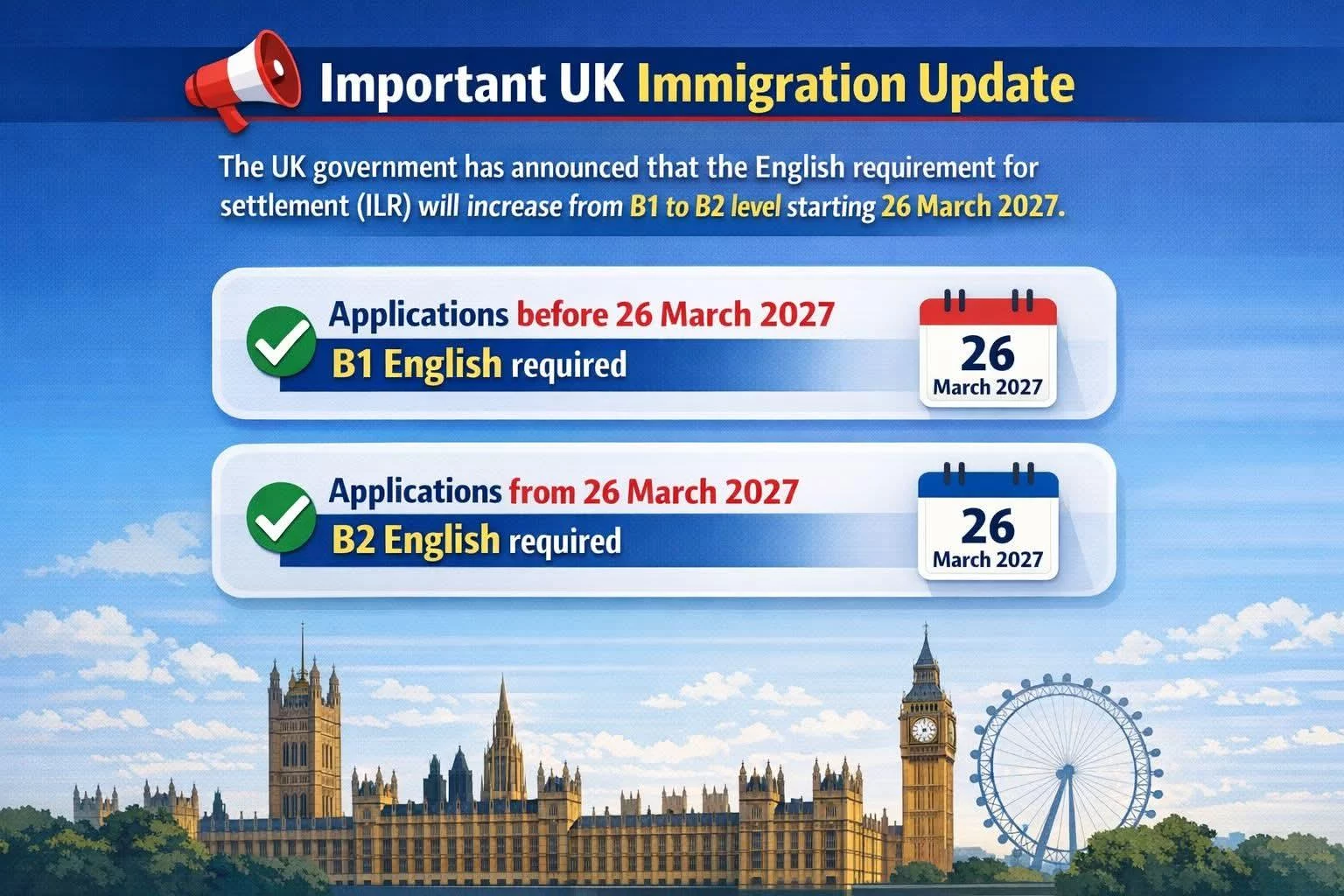
Applications Made Before 26 March 2027
Dependants applying for settlement before 26 March 2027 will generally need to demonstrate English language ability at CEFR Level B1 in speaking and listening.
B1 level represents an intermediate standard of English and requires applicants to communicate effectively in everyday situations, discuss familiar topics, and understand routine conversations.
Applications Made On or After 26 March 2027
The Home Office has announced changes that will increase the English language requirement for settlement applications.
From 26 March 2027, dependant partners applying for ILR will generally be required to meet CEFR Level B2 in speaking and listening.
B2 is a higher standard than B1 and reflects greater fluency and confidence in using English in both social and professional settings.
Applicants planning to apply for settlement after this date should prepare well in advance to ensure they can meet the higher language requirement.
Ways to Meet the English Language Requirement
The Home Office’s Appendix English Language sets out several ways in which applicants can satisfy the English language requirement for settlement.
Full details are available at:
https://www.gov.uk/guidance/immigration-rules/immigration-rules-appendix-english-language
Passing an Approved English Language Test
Many applicants meet the requirement by passing a Secure English Language Test (SELT) with an approved provider.
Approved test providers and accepted qualifications can be found on GOV.UK:
Holding a Degree Taught in English
Applicants who have obtained a degree-level qualification taught in English may be able to rely on that qualification to satisfy the requirement, provided it meets Home Office recognition criteria.
Being a National of a Majority English-Speaking Country
Citizens of certain majority English-speaking countries are automatically exempt from the English language requirement.
These countries include:
- Australia
- Canada
- New Zealand
- United States
- Jamaica
- Barbados
- Trinidad and Tobago
The complete list is available within Appendix English Language.
Using UK Educational Qualifications
Some applicants may be able to rely on GCSEs, A-levels, Scottish National Qualifications, or equivalent UK educational qualifications in English.
Further guidance is available from the Home Office:
https://www.gov.uk/government/publications/english-language-requirements-for-immigration-applicants
Exemptions from the Requirement
Not all applicants are required to meet the English language requirement.
The Immigration Rules provide exemptions for certain individuals, including those who:
- Are under the age of 18.
- Are aged 65 or over.
- Have a long-term physical or mental condition preventing them from meeting the requirement.
- Fall within specific categories recognised by the Home Office.
Applicants seeking an exemption should carefully review the relevant guidance and ensure that appropriate evidence is provided.
The Life in the UK Test
In addition to the English language requirement, most dependant partners applying for settlement must also pass the Life in the UK Test.
The test assesses an applicant’s knowledge of British history, culture, traditions, laws, and values.
Information about the test, preparation materials, and booking arrangements can be found at:
https://www.gov.uk/life-in-the-uk-test
Preparing for Settlement
Although English language evidence is not required during the initial stages of a dependant visa, it is advisable for partners to begin preparing early for settlement.
Developing English language skills from the outset can make everyday life easier, improve employment opportunities, support children’s education, and help applicants meet future immigration requirements.
Those intending to apply for ILR after March 2027 should pay particular attention to the planned increase from B1 to B2 level, as additional preparation may be required.
Conclusion
Dependant partners of Skilled Workers benefit from a relatively flexible immigration route, with no English language requirement for initial visa applications or extensions. However, English language ability becomes an important consideration when applying for settlement.
Most dependant partners seeking Indefinite Leave to Remain must demonstrate English language proficiency and pass the Life in the UK Test. With future changes expected to increase the required level of English, early preparation can help applicants avoid delays and strengthen their long-term prospects in the United Kingdom.
For the most up-to-date information, applicants should always consult the latest Immigration Rules and Home Office guidance available on GOV.UK before submitting an application.
Useful GOV.UK Resources
- Appendix Skilled Worker
- Appendix English Language
- Secure English Language Tests (SELT)
- English Language Requirements for Immigration Applicants
- Life in the UK Test
Disclaimer
This article is provided for general information purposes only and does not constitute legal, immigration, or professional advice. Immigration laws, policies, and Home Office guidance may change, and the information contained in this article may not reflect the most recent developments.
While every effort has been made to ensure the accuracy of the information at the time of publication, Hamlets Training Centre and Hamlets Desk make no representations or warranties, express or implied, regarding the completeness, accuracy, reliability, or suitability of the content.
Individuals should consult the latest guidance published on GOV.UK and seek advice from a qualified immigration adviser, solicitor, or regulated professional before making any immigration application or decision.
For the latest official information, please visit the UK Government website at https://www.gov.uk/.
[/fusion_text][/fusion_builder_column][/fusion_builder_row][/fusion_builder_container]