


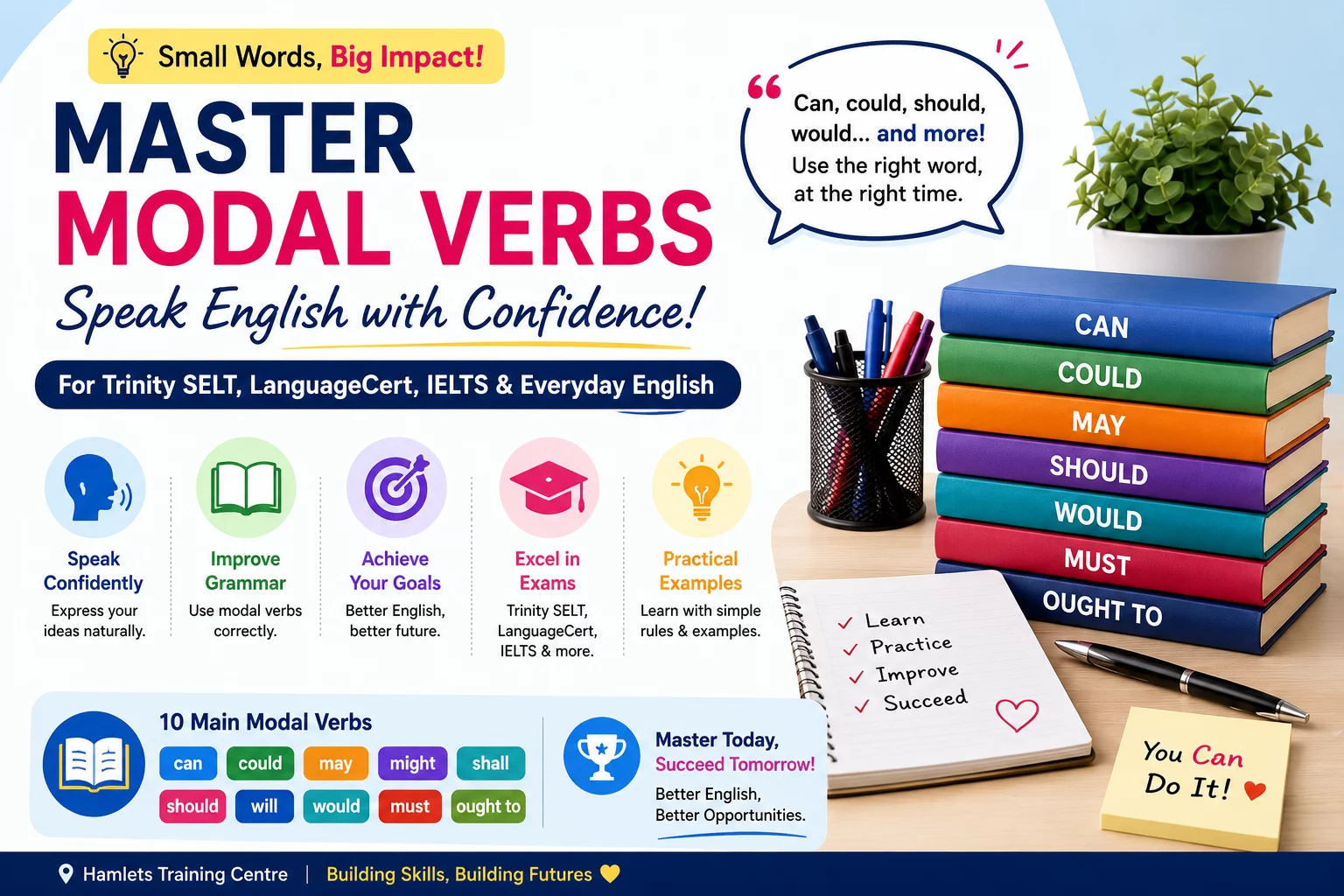
Can One Small Word Transform Your English?
Master English Modal Verbs with Confidence for Trinity SELT, LanguageCert, IELTS and Everyday English
Learn how simple words like can, could, should, and would can help you speak naturally, impress examiners, and communicate with confidence.
By Hamlets Desk | Hamlets Training Centre
Have you ever wondered why some English learners sound confident and natural while others struggle to express simple ideas? The difference is not always a larger vocabulary or more complicated grammar. Often, it comes down to knowing how to use modal verbs effectively.
Modal verbs are small words with a big impact. They help you ask polite questions, give advice, express possibility, make requests, and talk about the future. Whether you are preparing for Trinity SELT (GESE & ISE), LanguageCert SELT, IELTS, GCSE English, or simply improving your everyday English, mastering modal verbs will make your communication clearer, more fluent, and more natural.
What Are Modal Verbs?
Modal verbs are helping (auxiliary) verbs that are used with the base form of the main verb to express ability, permission, possibility, advice, obligation, certainty, or intention.
Structure:
Subject + Modal Verb + Base Verb
Examples
- I can speak English.
- She should revise every day.
- They might arrive late.
- You must wear a seatbelt.
Remember, the verb after a modal is always in its base form.
✔ She can drive.
❌ She can drives.
The 10 Main Modal Verbs
1. Can
Can is used to express ability, permission, possibility, and informal requests.
Examples
- I can swim.
- She can speak three languages.
- Can I use your phone?
- Can you help me?
Exam Tip: During your Trinity SELT or IELTS Speaking test, you can politely say, “Can you repeat the question, please?”
2. Could
Could is the past form of can, but it is also used for polite requests, suggestions, and possibilities.
Examples
- I could read when I was five.
- Could you open the window?
- We could visit Edinburgh this summer.
- It could rain later.
Using could instead of can often sounds more polite.
3. May
May is commonly used to ask for permission or express possibility.
Examples
- May I come in?
- You may leave early today.
- She may arrive after lunch.
In formal situations, may is often preferred over can.
4. Might
Might expresses a weaker possibility than may.
Examples
- It might snow tonight.
- I might travel abroad next year.
- He might be at work.
When you are unsure, might is usually the best choice.
5. Shall
Although less common in everyday conversation, shall is still used for offers, suggestions, and formal language.
Examples
- Shall we begin?
- Shall I carry your bag?
- The meeting shall start at 10 a.m.
6. Should
Should is used to give advice, recommendations, and expectations.
Examples
- You should study every day.
- We should exercise regularly.
- The train should arrive soon.
This is one of the most frequently used modal verbs in English.
7. Will
Will expresses the future, promises, decisions, and willingness.
Examples
- I will call you tomorrow.
- She will help you.
- We will finish the project next week.
8. Would
Would makes English sound more polite and natural. It is used for polite requests, preferences, and imaginary situations.
Examples
- Would you like some coffee?
- I would like to study medicine.
- I would travel the world if I had enough money.
Learners preparing for speaking exams should use would regularly because it demonstrates a higher level of communication.
9. Must
Must expresses strong obligation, necessity, and certainty.
Examples
- You must wear a seatbelt.
- Students must complete their homework.
- She has been studying all day. She must be tired.
10. Ought to
Ought to has a similar meaning to should, but it often expresses a stronger sense of moral responsibility.
Examples
- We ought to protect the environment.
- You ought to apologise.
- People ought to respect each other.
Common Mistakes
Many learners make the same mistakes when using modal verbs.
Incorrect: He can sings.
Correct: He can sing.
Incorrect: She must to go.
Correct: She must go.
Incorrect: Do you must leave?
Correct: Must you leave?
Learning these simple rules will make your English much more accurate.
Why Are Modal Verbs Important for English Exams?
Modal verbs appear regularly in Trinity SELT, LanguageCert, IELTS, GCSE English, and other English examinations. Examiners expect candidates to use them naturally when answering questions, giving opinions, making suggestions, or talking about future plans.
For example:
- I would like to become a teacher.
- I might visit my family this weekend.
- Everyone should recycle more.
- I can communicate confidently in English.
These expressions make your answers sound fluent and well developed.
Final Thoughts
Modal verbs may be small, but they play a vital role in English communication. They help you express your thoughts clearly, politely, and confidently in everyday conversations, the workplace, academic settings, and English examinations.
The more you practise using can, could, may, might, shall, should, will, would, must, and ought to, the more natural your English will become.
At Hamlets Training Centre, we believe that learning grammar should never be about memorising rules alone. Our experienced tutors help learners use grammar confidently through practical speaking, listening, reading, and writing activities. Whether you are preparing for Trinity SELT, LanguageCert, IELTS, GCSE English, or simply improving your everyday English, we are here to help you achieve your goals.
Remember: Great English isn’t about using difficult words—it’s about choosing the right words at the right time. Master modal verbs today, and you’ll take another important step towards speaking English with confidence.