


YOUR ENGLISH, YOUR FUTURE
From A1 to C2: IELTS, IELTS Life Skills, Trinity SELT, UK Immigration, Settlement and the Life in the UK Test
Hamlets Desk | Hamlets Training Centre
Updated: 3 November 2026
INTRODUCTION: ENGLISH IS MORE THAN AN IMMIGRATION REQUIREMENT
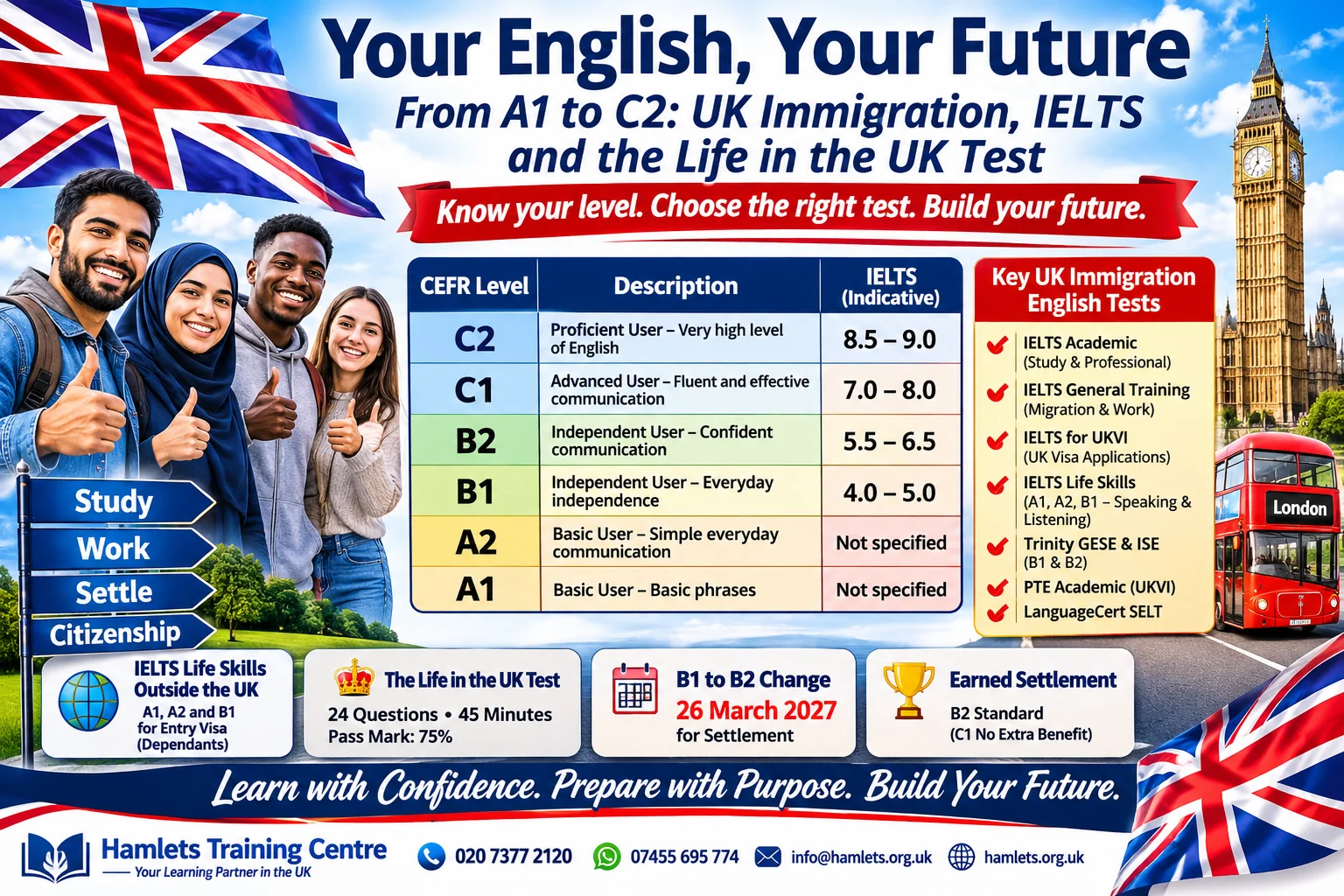
For millions of people who have chosen to make the United Kingdom their home, learning English is an important part of building a successful future.
It is about confidence, independence, opportunity and belonging.
English helps people communicate with employers, support their children’s education, access healthcare, understand public services, develop professional careers and participate in their local communities.
For some learners, the journey begins with a few simple words and everyday expressions. Others are working towards intermediate or advanced English to improve their employment opportunities, pursue higher education or prepare for settlement.
Wherever you begin, every step forward is an achievement.
The latest Home Office announcements and the Government’s response to the Earned Settlement consultation, published on 2 November 2026, make preparation particularly important for people planning to settle permanently in the UK.
The Government’s new settlement framework places considerable importance on English language ability, contribution, integration and knowledge of life in the UK.
This article explains the English levels from A1 to C2, how they compare with IELTS, the difference between IELTS Life Skills and IELTS Academic or General Training, and the English examinations commonly used for UK immigration applications.
It also explains the Life in the UK Test and how learners can prepare for the next stage of their journey.
PART 1 – UNDERSTANDING ENGLISH LANGUAGE LEVELS: A1 TO C2
1. What is CEFR?
CEFR stands for the Common European Framework of Reference for Languages.
It is an internationally recognised framework used to describe a person’s language ability.
There are six levels:
| Level | Description | General ability |
|---|---|---|
| A1 | Beginner | Basic words and expressions |
| A2 | Elementary | Simple everyday communication |
| B1 | Intermediate | Independent communication in familiar situations |
| B2 | Upper Intermediate | Confident communication on a wider range of subjects |
| C1 | Advanced | Fluent and effective communication in complex situations |
| C2 | Proficiency | Very high level of language ability |
The levels are grouped into three categories:
- A1 and A2 – Basic User.
- B1 and B2 – Independent User.
- C1 and C2 – Proficient User.
Understanding these levels helps learners identify their current ability and plan their next stage of development.
2. A1 – Beginner: Building the foundations
A1 is the first level of English language learning.
At this stage, learners develop the ability to understand and use familiar everyday expressions.
A learner working at A1 should be able to:
- Introduce themselves.
- Give their name and personal information.
- Talk about their family.
- Ask and answer simple questions.
- Understand basic instructions.
- Use greetings and everyday expressions.
Example:
“My name is Ali. I live in London. I have two children. I work in a restaurant.”
These sentences are simple, but they are important building blocks.
IELTS comparison: IELTS does not publish a specific official IELTS band range for A1 in its CEFR alignment table.
Immigration relevance: A1 is required for certain first applications under the Family visa route, particularly relevant partner and parent applications.
Motivational message: Never underestimate the first step. Every confident English speaker was once a beginner.
3. A2 – Elementary: Communicating in everyday situations
A2 is the next level after A1.
At this stage, learners can communicate more confidently in familiar situations.
A learner working at A2 should be able to:
- Describe their daily routine.
- Talk about shopping and travel.
- Explain their family circumstances.
- Discuss work and everyday activities.
- Ask for information.
- Understand simple conversations.
- Describe past experiences using basic language.
Example:
“I usually start work at nine o’clock. I travel by bus. After work, I go home and spend time with my family.”
IELTS comparison: IELTS does not publish a specific official IELTS band range for A2 in its CEFR alignment table.
Immigration relevance: A2 is particularly important for certain Family visa extension applications following an initial A1 application.
It also has a specific role in the Government’s new arrangements for refugees admitted through the UK Resettlement Scheme.
4. B1 – Intermediate: Becoming an independent English speaker
B1 is an important stage in English language development.
At this level, learners can communicate independently in many everyday situations.
A B1 learner should be able to:
- Explain opinions.
- Give reasons for decisions.
- Describe past experiences.
- Talk about future plans.
- Discuss familiar topics.
- Understand the main points of clear conversations.
- Participate in everyday discussions.
Example:
“I believe learning English is important because it helps people find better employment opportunities and communicate more confidently with others.”
Indicative IELTS comparison: IELTS 4.0–5.0 overall.
This is an approximate CEFR alignment, not an automatic equivalence.
Immigration relevance: B1 remains relevant to specified immigration applications, including certain Student applications below degree level and International Agreement (Temporary Work) applications. It also remains relevant to settlement applications under existing provisions before the B2 change takes effect.
Important settlement change: From 26 March 2027, B2 will replace B1 for settlement under the specified routes affected by the Immigration Rules changes.
Motivational message: If you have achieved B1, you have made significant progress. Your next target may be B2, particularly if the new settlement requirement applies to your circumstances.
5. B2 – Upper Intermediate: Communicating with confidence
B2 is an upper-intermediate level of English.
It demonstrates a stronger ability to understand information, express opinions and participate in more complex conversations.
A B2 learner should be able to:
- Discuss a wide range of subjects.
- Explain advantages and disadvantages.
- Express opinions with supporting reasons.
- Understand detailed spoken information.
- Participate confidently in discussions.
- Use a wider range of vocabulary.
- Organise ideas into clear and connected sentences.
Example:
“In my opinion, learning English should be a continuous process because effective communication can improve employment opportunities, strengthen relationships and help individuals become more active members of society.”
Indicative IELTS comparison: IELTS 5.5–6.5 overall.
Immigration relevance: B2 is already required for several immigration routes, including Skilled Worker, High Potential Individual and Innovator Founder, subject to the relevant route rules and transitional provisions.
B2 also applies to Student applicants studying at UK bachelor’s degree level or above.
From 26 March 2027, B2 will replace B1 for settlement under the specified routes affected by the changes.
6. C1 – Advanced: Developing professional and academic English
C1 is an advanced level of English.
A C1 learner can understand demanding language and communicate fluently and effectively in professional, academic and social situations.
A learner working at C1 should be able to:
- Understand complex and extended texts.
- Express ideas fluently and spontaneously.
- Discuss abstract and technical subjects.
- Use language flexibly for different purposes.
- Explain complex arguments.
- Communicate effectively in professional environments.
Example:
“Developing advanced language proficiency enables individuals to communicate with precision, evaluate complex information and participate effectively in academic, professional and social environments.”
Indicative IELTS comparison: IELTS 7.0–8.0 overall.
Does C1 provide faster settlement?
The original Earned Settlement consultation considered whether applicants demonstrating C1 English should receive a reduction in their settlement qualifying period.
However, the Government’s response published on 2 November 2026 confirms that C1 English will not provide an additional reduction in the qualifying period.
The Government has selected B2 as the standard English requirement under the new Earned Settlement framework, subject to exemptions and specific arrangements.
C1 remains a valuable achievement for education, employment and personal development, but it does not provide the additional settlement-period reduction considered in the original consultation.
Official reference: A Fairer Pathway to Settlement: Government Response to the Consultation, November 2026, Chapter 3, English Language section.
7. C2 – Proficiency: Reaching the highest CEFR level
C2 is the highest level in the CEFR framework.
It represents a very high level of language proficiency.
A C2 user should be able to:
- Understand virtually everything heard or read.
- Summarise information from different spoken and written sources.
- Express ideas spontaneously and precisely.
- Understand subtle differences in meaning.
- Communicate effectively in complex situations.
- Use language flexibly for academic, professional and social purposes.
Example:
“Effective communication requires not only an extensive vocabulary but also the ability to interpret context, recognise nuance and convey complex ideas with clarity and precision.”
Indicative IELTS comparison: IELTS 8.5–9.0 overall.
C2 is an advanced educational and language-development goal. It is not a standard English level required by the main UK immigration routes discussed in this article.
PART 2 – CEFR AND IELTS: HOW DO THEY COMPARE?
8. A1 to C2 compared with IELTS band scores
IELTS uses a nine-band scoring system, while CEFR uses six proficiency levels.
IELTS publishes an indicative alignment between its overall band scores and CEFR levels.
| CEFR level | General description | Indicative IELTS overall band |
|---|---|---|
| A1 | Beginner | No specific range published |
| A2 | Elementary | No specific range published |
| B1 | Intermediate | 4.0–5.0 |
| B2 | Upper Intermediate | 5.5–6.5 |
| C1 | Advanced | 7.0–8.0 |
| C2 | Proficiency | 8.5–9.0 |
Important: These are approximate comparisons, not automatic equivalents. IELTS and CEFR use different assessment systems. A particular IELTS score does not automatically prove that an applicant meets a UK immigration requirement.
For immigration purposes, the Home Office specifies the approved test, CEFR level and minimum scores required in the relevant components.
Official IELTS reference: Your Guide to Understanding and Using IELTS Scores, 2025, section on IELTS and CEFR alignment.
9. Understanding the IELTS nine-band scale
| IELTS band | General description |
|---|---|
| 9 | Expert user |
| 8 | Very good user |
| 7 | Good user |
| 6 | Competent user |
| 5 | Modest user |
| 4 | Limited user |
| 3 | Extremely limited user |
| 2 | Intermittent user |
| 1 | Non-user |
| 0 | Did not attempt the test |
IELTS assesses four language skills:
- Listening.
- Reading.
- Writing.
- Speaking.
The overall band score is calculated from the four individual skill scores.
Some universities, employers and immigration routes also require minimum scores in individual components.
Official source: IELTS, Your Guide to Understanding and Using IELTS Scores.
PART 3 – IELTS ACADEMIC, GENERAL TRAINING AND IELTS FOR UKVI
10. What is the difference between IELTS Academic and IELTS General Training?
This is an important distinction for anyone considering an English language examination.
IELTS offers different test formats for different purposes.
IELTS Academic
IELTS Academic is designed mainly for people who want to study at undergraduate or postgraduate level in an English-speaking environment.
It is also used for certain professional registration purposes.
The test assesses four skills:
- Listening.
- Reading.
- Writing.
- Speaking.
The Reading and Writing sections contain academic-style material.
Typical purpose:
- University admission.
- Higher education.
- Certain professional registration requirements.
Official information: IELTS Academic
IELTS General Training
IELTS General Training is designed for people who need English for everyday communication, employment, training or migration.
It also assesses four skills:
- Listening.
- Reading.
- Writing.
- Speaking.
The Listening and Speaking sections are the same as IELTS Academic, but the Reading and Writing sections differ.
General Training uses material related to everyday life, work and social situations.
Typical purpose:
- Migration.
- Work-related opportunities.
- Training.
- Study below degree level.
Official information: IELTS General Training
IELTS for UKVI
IELTS for UKVI is a Secure English Language Test (SELT) approved for specified UK visa and immigration applications.
The IELTS for UKVI tests have the same basic test format and scoring system as their corresponding standard IELTS versions, but they are delivered under additional UKVI security arrangements at approved test locations.
The relevant options include:
- IELTS for UKVI Academic.
- IELTS for UKVI General Training.
- IELTS for UKVI Life Skills A1.
- IELTS for UKVI Life Skills A2.
- IELTS for UKVI Life Skills B1.
Important: Ordinary IELTS Academic or General Training is not automatically acceptable for a UK immigration application requiring a SELT. Applicants must book the correct UKVI-approved test at an approved location.
Official information: IELTS for UK Visas and Immigration
PART 4 – IELTS LIFE SKILLS: A1, A2 AND B1
11. What is IELTS Life Skills?
IELTS Life Skills is a UKVI-approved English language test designed for applicants who need to demonstrate their speaking and listening ability.
Unlike IELTS Academic and General Training, IELTS Life Skills does not assess reading and writing.
It is particularly relevant to certain Family visa applications, settlement applications and citizenship applications.
The examination focuses on practical communication and everyday situations.
Candidates may be asked to discuss familiar topics such as:
- Family and relationships.
- Work and employment.
- Travel and transport.
- Shopping.
- Education.
- Hobbies and interests.
- Everyday activities.
- Plans and experiences.
The assessment looks at a candidate’s ability to listen, respond, communicate information and interact with another person.
How is IELTS Life Skills assessed?
IELTS Life Skills is not marked using the IELTS 0–9 band system.
Candidates receive either:
- Pass.
- Fail.
A Pass means the candidate has successfully met the required standard for that particular Life Skills level.
12. IELTS Life Skills A1 – For certain first Family visa applications
IELTS Life Skills A1 assesses basic speaking and listening ability.
It is particularly relevant to certain first applications under the Family route, including partner and parent applications.
The test is available both in the UK and overseas.
This is especially important for applicants who are living outside the UK and planning to join their husband, wife or partner in Britain.
Example: A person living overseas who is applying for an initial partner visa under the Family route may need to demonstrate A1 speaking and listening, unless exempt or able to meet the requirement through another permitted method.
The applicant can take IELTS Life Skills A1 at an approved overseas test location.
Official information: IELTS Life Skills A1
13. IELTS Life Skills A2 – For certain Family visa extensions
A2 is the next stage after A1.
It is relevant to certain applicants extending their permission under the Family visa route.
The IELTS Life Skills A2 test assesses speaking and listening at elementary level.
Important availability point: IELTS states that its Life Skills A2 test is offered in the UK only. Applicants should therefore check the availability and location requirements before booking.
Official information: IELTS Life Skills test format
14. IELTS Life Skills B1 – For settlement and citizenship
B1 is an intermediate level.
IELTS Life Skills B1 is designed for applicants who need to demonstrate B1 speaking and listening for relevant settlement or citizenship applications.
The examination assesses the candidate’s ability to:
- Understand spoken English.
- Respond appropriately.
- Explain information.
- Express opinions.
- Discuss familiar subjects.
- Participate in conversations.
Candidates receive a Pass or Fail result.
Important: IELTS Life Skills is currently available at A1, A2 and B1. There is no IELTS Life Skills B2 examination.
If an applicant needs B2, they must select an appropriate approved four-skills SELT where the immigration route requires all four skills, or another approved assessment meeting the precise requirements of that route.
PART 5 – IELTS LIFE SKILLS OUTSIDE THE UK: IMPORTANT INFORMATION FOR ENTRY VISA APPLICANTS
15. Can someone take IELTS Life Skills outside the UK?
Yes.
IELTS Life Skills A1 is available internationally at approved IELTS for UKVI test locations.
This is particularly relevant for people applying for entry clearance under the Family visa route.
For example:
A husband or wife living in Bangladesh, Pakistan, India or another country may be applying to join their British citizen or settled partner in the UK.
If the applicant is required to demonstrate A1 English through a speaking and listening test, IELTS Life Skills A1 may be an appropriate option, provided it is taken at an approved UKVI SELT location and meets the applicable Immigration Rules.
IELTS Life Skills outside the UK: A1, A2 and B1
| Test | Main purpose | Availability |
|---|---|---|
| IELTS Life Skills A1 | Certain first Family visa applications | UK and overseas |
| IELTS Life Skills A2 | Certain Family visa extensions | UK only, according to IELTS |
| IELTS Life Skills B1 | Relevant settlement and citizenship applications | UK and overseas |
Important: The availability of a test does not mean that every applicant needs that test. The required level depends on the visa category and application stage.
What about dependants of Skilled Workers and Students?
This is a particularly important distinction.
A spouse or child applying as a dependant of a Skilled Worker or Student is not automatically subject to the same A1 entry requirement that applies to a first partner application under the Family visa route.
The immigration category matters.
The Government’s Earned Settlement framework also contains proposals and arrangements concerning adult dependants and settlement. Applicants should check the final rules applicable to their category rather than assume that all dependants have the same English requirement.
Advice: Before booking an overseas test, identify the exact visa route, the applicant’s relationship to the main visa holder and whether the application is for entry clearance, an extension or settlement.
Where can overseas applicants take an approved SELT?
The Home Office recognises specific providers for tests taken outside the UK.
The approved providers listed in its SELT guidance are:
- IELTS SELT Consortium.
- LanguageCert.
- Pearson.
- PSI Services (UK) Ltd.
Trinity College London is an approved SELT provider in the UK, but it is not listed by the Home Office as an overseas SELT provider.
Applicants must use an approved test and approved test centre.
Official source: GOV.UK – Prove your English language abilities with a Secure English Language Test
PART 6 – POPULAR B1 AND B2 ENGLISH TESTS IN THE UK
16. Which B1 and B2 English tests are commonly used in the UK?
There are several Home Office-approved English language test options.
The most suitable examination depends on whether the immigration application requires speaking and listening only or all four skills.
For many applicants, the choice is between a speaking and listening test and a four-skills test.
Popular B1 tests
| Provider | Test | Skills assessed | Level |
|---|---|---|---|
| Trinity College London | GESE Grade 5 | Speaking and listening | B1 |
| Trinity College London | ISE I | Reading, writing, speaking and listening | B1 |
| IELTS SELT | IELTS Life Skills B1 | Speaking and listening | B1 |
| IELTS SELT | IELTS for UKVI Academic/General | Four skills | B1, where approved and required |
| Pearson | PTE Home B1 | Speaking and listening | B1 |
| Pearson | PTE Academic UKVI | Four skills | B1, where approved and required |
| LanguageCert | Approved B1 SELT | Two or four skills, depending on the test | B1 |
| PSI | Skills for English UKVI | Relevant approved components | B1 |
Popular B2 tests
| Provider | Test | Skills assessed | Level |
|---|---|---|---|
| Trinity College London | GESE Grade 7 | Speaking and listening | B2 |
| Trinity College London | ISE II | Reading, writing, speaking and listening | B2 |
| IELTS SELT | IELTS for UKVI Academic | Four skills | B2 |
| IELTS SELT | IELTS for UKVI General Training | Four skills | B2 |
| Pearson | PTE Academic UKVI | Four skills | B2 |
| LanguageCert | Approved B2 SELT | Four skills | B2 |
| PSI | Skills for English UKVI | Relevant approved components | B2 |
Important: The table is a guide to the main examination types. Applicants must check the current Home Office approved test list for the exact test name, CEFR level, minimum component scores and test availability.
17. Trinity College London: GESE and ISE
Trinity College London offers two different examination formats relevant to UK immigration.
GESE – Graded Examinations in Spoken English
GESE assesses speaking and listening.
The relevant levels include:
| Examination | CEFR level | Skills |
|---|---|---|
| GESE Grade 2 | A1 | Speaking and listening |
| GESE Grade 3 | A2 | Speaking and listening |
| GESE Grade 5 | B1 | Speaking and listening |
| GESE Grade 7 | B2 | Speaking and listening |
GESE is particularly relevant for applicants whose immigration route requires speaking and listening rather than all four language skills.
ISE – Integrated Skills in English
ISE assesses the four language skills.
The relevant levels include:
| Examination | CEFR level | Skills |
|---|---|---|
| ISE I | B1 | Reading, writing, speaking and listening |
| ISE II | B2 | Reading, writing, speaking and listening |
ISE is relevant to applicants whose route requires all four skills, provided the exact examination and result meet the Home Office requirements.
Official information: Trinity College London – SELT
18. Which is the difference between a two-skills and four-skills examination?
This is one of the most important questions for applicants.
Two-skills examination
A two-skills test assesses:
- Speaking.
- Listening.
Examples include:
- Trinity GESE Grade 5 – B1.
- Trinity GESE Grade 7 – B2.
- IELTS Life Skills A1, A2 and B1.
- Pearson PTE Home at approved levels.
These tests are relevant where the immigration rules require speaking and listening only.
Four-skills examination
A four-skills test assesses:
- Speaking.
- Listening.
- Reading.
- Writing.
Examples include:
- Trinity ISE I – B1.
- Trinity ISE II – B2.
- IELTS for UKVI Academic.
- IELTS for UKVI General Training.
- Pearson PTE Academic UKVI.
- Approved LanguageCert SELT examinations.
These tests are relevant where the immigration route requires all four language skills.
Do not assume that a B2 speaking and listening test meets a B2 four-skills requirement. The test must match the requirements of the immigration route.
PART 7 – IELTS SCORE REQUIREMENTS FOR UK IMMIGRATION
19. What IELTS scores correspond to B1, B2 and C1 for UKVI tests?
For the IELTS for UKVI four-skills tests, the published minimum scores are:
| CEFR level | Listening | Reading | Writing | Speaking |
|---|---|---|---|---|
| B1 | 4.0 | 4.0 | 4.0 | 4.0 |
| B2 | 5.5 | 5.5 | 5.5 | 5.5 |
| C1 | 7.0 | 7.0 | 7.0 | 7.0 |
These are the IELTS UKVI minimum scores published for the corresponding CEFR levels.
Important: The required level depends on the immigration route. Applicants must achieve the minimum required score in each relevant component, not merely the overall IELTS band.
For example, an applicant who achieves an overall IELTS score of 6.0 but receives 5.0 in writing would not meet a requirement of 5.5 in every component.
The Home Office approved test list and the relevant Immigration Rules determine whether the examination is suitable.
Official information: IELTS for UKVI – Test and score requirements
PART 8 – WHICH ENGLISH LEVEL IS REQUIRED FOR DIFFERENT UK VISA ROUTES?
20. Understanding the main immigration categories
The English language requirement depends on the visa route and the type of application.
The Home Office’s published guidance identifies the following requirements for the routes listed below.
| Immigration route | English requirement |
|---|---|
| Family visa – first partner or parent application | A1 |
| Family visa – extension | A2 |
| Student – degree level or above | B2 |
| Student – below degree level | B1 |
| Skilled Worker | B2, subject to transitional arrangements |
| T2 Minister of Religion | B2 |
| Representative of an Overseas Business | A1 |
| High Potential Individual | B2 |
| Scale-up | B2, subject to transitional arrangements |
| Innovator Founder | B2 |
| International Sportsperson – applications exceeding 12 months | A1 |
| International Agreement – Temporary Work | B1 |
These are the requirements in the relevant published guidance. Applicants must also consider exemptions, transitional arrangements and route-specific rules.
Family visa applicants
The Family visa route has a progression of English requirements:
- First relevant partner or parent application: A1.
- Relevant extension: A2.
- Settlement: B1 under the existing rules before the relevant change, increasing to B2 from 26 March 2027 for the specified applications.
Skilled Worker applicants
The B2 English requirement applies to new Skilled Worker applications under the relevant rules introduced in January 2026.
Applicants who previously met B1 under the earlier rules may benefit from specified transitional arrangements when extending or applying for settlement.
Student applicants
The English requirement depends on the academic level of the course:
- B2 for courses at UK bachelor’s degree level or above.
- B1 for courses below UK bachelor’s degree level.
Official source: English language requirement levels for immigration applications – GOV.UK
PART 9 – THE B1 TO B2 SETTLEMENT CHANGE: 26 MARCH 2027
21. What happens on 26 March 2027?
The Home Office has confirmed an important change to the English language requirement for settlement.
For the specified immigration routes:
- Before 26 March 2027, the existing B1 requirement generally applies where the relevant route requires B1.
- From 26 March 2027, B2 will replace B1 for the settlement applications covered by the change.
For the relevant Family settlement provisions, the requirement is B2 speaking and listening.
This means that applicants planning to apply for settlement should consider their expected application date and the rules that will apply to their route.
Someone who has already achieved B1 should not assume that the same qualification will automatically satisfy a later B2 requirement.
Official references:
- Explanatory Memorandum to HC 1691, paragraphs 5.60–5.62.
- Immigration Rules, Appendix Settlement Family Life, paragraph SETF 5.1.
- Home Office announcement, 5 March 2026.
Official announcement: Higher standard of English now required to settle in the UK
PART 10 – EARNED SETTLEMENT AND THE C1 DECISION
22. What did the Government announce on 2 November 2026?
On 2 November 2026, the Home Office published its Government Response to the Earned Settlement consultation.
The Government’s framework places importance on:
- Good character and suitability.
- Outstanding Government debt.
- Strong English language ability.
- Passing the Life in the UK Test, subject to exemptions and special arrangements.
- Sustained contribution to the UK.
The framework identifies a ten-year starting point, with shorter qualifying periods for specified categories of applicants who meet the relevant conditions.
The Government has confirmed B2 as the standard English requirement under the Earned Settlement framework.
It has also confirmed that C1 English will not provide an additional reduction in the settlement qualifying period.
This is important because the original consultation considered a one-year reduction for applicants with C1 English.
The final Government Response should be used when explaining the Government’s current position, rather than presenting the earlier consultation proposal as an approved benefit.
Official source: A Fairer Pathway to Settlement – Government Response
PART 11 – THE LIFE IN THE UK TEST
23. Understanding the Life in the UK Test
English language ability is one important part of integration. Understanding the United Kingdom is another.
The Life in the UK Test is an established requirement for most people applying for settlement and British citizenship, subject to exemptions.
It assesses knowledge of the United Kingdom, including:
- British history.
- Important historical events.
- Parliament and democracy.
- Government and the law.
- British traditions and customs.
- Rights and responsibilities.
- Everyday life in the UK.
The test is designed to assess whether applicants have an understanding of the country in which they intend to live permanently or become citizens.
24. What is the Life in the UK Test format?
| Test information | Details |
|---|---|
| Number of questions | 24 |
| Duration | 45 minutes |
| Format | Computer-based multiple choice |
| Pass mark | 75% |
| Correct answers required | 18 out of 24 |
| Current official fee | £50 |
The questions are based on the official handbook:
Life in the United Kingdom: A Guide for New Residents.
Candidates should study the official handbook rather than rely entirely on unofficial online questions.
The test can be retaken if a candidate does not pass, but a new booking fee is payable.
Official sources:
25. How should you prepare?
A structured preparation programme can make the process easier.
Week 1 – British history
Study important historical events, monarchs and developments in British society.
Week 2 – Government and democracy
Understand Parliament, the Prime Minister, elections, local government and the legal system.
Week 3 – British society
Study traditions, customs, cultural life, rights and responsibilities.
Week 4 – Revision and practice
Revise the official handbook, complete practice questions and identify areas that need improvement.
Final preparation
Practise timed tests and aim to achieve consistently above the required pass mark.
Do not leave preparation until the last minute. Regular study is more effective than trying to learn everything in a few days.
PART 12 – HOW TO IMPROVE YOUR ENGLISH AND PREPARE WITH CONFIDENCE
26. A practical learning plan from A1 to B2
Whether you are preparing for A1, A2, B1 or B2, regular practice is essential.
Speaking
Practise speaking English every day.
Talk about your family, work, education, interests and future plans.
Try to explain your opinions rather than simply giving one-word answers.
Listening
Listen to English news, interviews, educational programmes and everyday conversations.
Try to identify the main points and important details.
Reading
Read short articles, notices, letters and information from reliable sources.
Build your vocabulary and practise understanding unfamiliar words from context.
Writing
Practise writing sentences, short paragraphs, emails and descriptions.
Focus on grammar, punctuation, vocabulary and clear organisation.
Grammar
Develop your understanding of:
- Present, past and future tenses.
- Question forms.
- Modal verbs.
- Conditional sentences.
- Linking words.
- Sentence structures.
- Giving reasons and expressing opinions.
Vocabulary
Learn useful vocabulary connected with everyday life, employment, education, healthcare, travel and society.
Use new words in your own sentences.
27. How long does it take to move from one level to another?
There is no fixed period for progressing between CEFR levels.
The time depends on:
- Your current English ability.
- Previous learning experience.
- The amount of time you practise.
- Your opportunities to use English.
- The quality of teaching and feedback.
- Your confidence and motivation.
Some learners progress quickly, while others need more time.
The most important factor is consistency.
Even 20–30 minutes of focused English practice each day can help you make progress.
PART 13 – YOUR FUTURE STARTS WITH LEARNING
28. A message to everyone building a life in the UK
For many people, moving to the United Kingdom has been a journey of courage, sacrifice and determination.
Some came to study. Some arrived for employment. Others joined their partners and families. Many have raised children here, established businesses, developed careers and become active members of their communities.
Every journey is different.
But one thing is common: the ability to communicate confidently can make a significant difference to everyday life.
English can help you:
- Support your children’s education.
- Communicate effectively at work.
- Access healthcare and public services.
- Develop professional skills.
- Build stronger relationships.
- Participate in community activities.
- Understand your rights and responsibilities.
Learning about British history, institutions and traditions can also help you feel more informed and connected to the country.
Do not see an English language test or the Life in the UK Test simply as an obstacle.
See them as opportunities to learn, develop and prepare for the next chapter of your life.
If you are at A1, keep going.
If you have achieved A2, continue developing your independence.
If you are working towards B1, build your confidence.
If B2 is your next target, prepare early and practise consistently.
If you have achieved C1 or C2, continue using your advanced English to support your academic and professional ambitions.
Your starting point does not determine your destination. Your commitment to learning can open new opportunities.
PART 14 – HAMLETS TRAINING CENTRE: SUPPORTING YOUR LEARNING JOURNEY
At Hamlets Training Centre, we believe education should empower people and create opportunities.
Our aim is to help learners develop the language skills, knowledge and confidence they need for their personal, professional and educational journeys.
Hamlets has supported candidates preparing for Trinity English language examinations since 2007 and has been a Trinity SELT Approved Service Provider since 2011.
We provide English language learning and preparation support for relevant Trinity SELT examinations, including preparation for different CEFR levels and speaking and listening requirements.
Our preparation support includes:
- A1 English preparation.
- A2 English preparation.
- B1 English preparation.
- B2 English preparation.
- Trinity GESE and ISE examination preparation.
- Speaking and listening practice.
- Four-skills English development.
- Life in the UK Test preparation.
We also help learners understand the differences between immigration English tests so that they can identify the examination appropriate to their circumstances.
Whether you are starting your English journey at A1, progressing towards A2 or B1, preparing for B2 or developing advanced C1 communication, the first step is to identify your learning needs and follow a suitable programme.
Do not wait until your immigration application deadline is approaching. Start preparing today.
Contact Hamlets Training Centre
Hamlets Training Centre | Hamlets Desk
Unit GM2, Montefiore Centre
Hanbury Street, London E1 5HZ
Telephone: 020 7377 2120
WhatsApp: 07455 695 774
Email: info@hamlets.org.uk
Website: hamlets.org.uk
Evening and weekend courses available. Visits by appointment.
FINAL MESSAGE: LEARN WITH CONFIDENCE. PREPARE WITH PURPOSE. BUILD YOUR FUTURE.
A test certificate may help demonstrate that you meet an immigration requirement, but the knowledge, communication skills and confidence you gain through learning can benefit you throughout your life.
Learning English is an investment in yourself.
Understanding life in the UK is an investment in your future.
Start where you are. Learn at your own pace. Keep moving forward.
Hamlets Desk | Hamlets Training Centre