


Have You Really Mastered the 12 English Tenses?
The Hidden Reason Why Many Learners Struggle to Pass Secure English Language Test (SELT) – And How You Can Succeed
By Hamlets Desk
“I’ve studied English for years… so why do I still find the B2 exam difficult?”
If you’ve ever asked yourself this question, you’re not alone.
Every year, thousands of learners prepare for the Trinity Secure English Language Test (SELT), including the Trinity ISE II (B2) qualification. Many have spent years learning English in school, college or university. They know grammar terminology, recognise the names of the tenses and often achieve good marks in written exercises.
Yet when it comes to the speaking and listening components of the examination, many lose confidence.
Why?
Because knowing English grammar is very different from using English naturally in real-life communication.
That distinction often determines whether a learner merely passes—or performs with confidence.
The Trinity B2 Examination Tests Communication, Not Memorisation
The Trinity B2 examination is designed to assess your ability to communicate effectively in English. It is not simply a test of grammar knowledge or vocabulary lists.
During the examination, you are expected to demonstrate that you can:
- speak fluently and confidently
- express opinions and justify ideas
- describe experiences and events
- discuss current issues
- speculate about possibilities
- explain future plans
- respond naturally to follow-up questions
To achieve this, you must move confidently between different English tenses without stopping to think about grammar rules.
That is what real communication looks like.
Could You Do This in Your Exam?
Imagine the examiner begins with a simple question:
“Tell me about a challenge you have overcome.”
You immediately need the Past Simple.
As you explain the situation, you naturally introduce the Past Continuous.
The examiner then asks:
“How has that experience changed your life?”
Now you need the Present Perfect.
A few moments later comes another question:
“What will you do differently in the future?”
Without hesitation, you move into the Future Simple.
Within just a few minutes, you may have used four or five different tenses.
Strong candidates do this naturally.
They are not translating from their first language.
They are not trying to remember grammar rules.
They are communicating.
And that is exactly what Trinity examiners are looking for.
Do You Really Know the 12 English Tenses—or Can You Use Them?
This is perhaps the most important question every B2 learner should ask themselves.
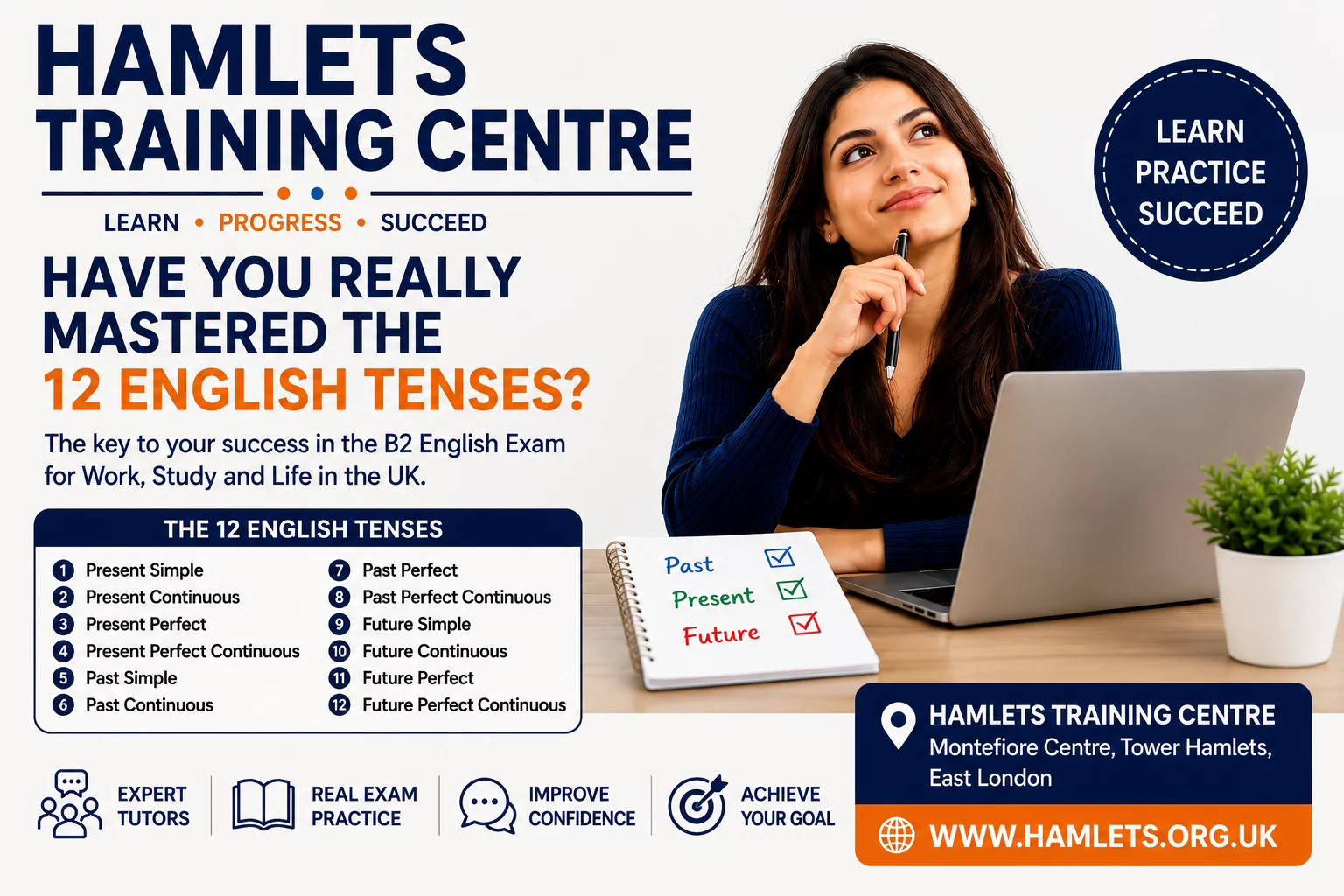
Can you confidently use all twelve English tenses during a conversation?
- Present Simple
- Present Continuous
- Present Perfect
- Present Perfect Continuous
- Past Simple
- Past Continuous
- Past Perfect
- Past Perfect Continuous
- Future Simple
- Future Continuous
- Future Perfect
- Future Perfect Continuous
These are far more than grammar topics.
They are the foundation of effective communication.
Every tense enables you to explain ideas with greater accuracy, describe time relationships, express experiences and communicate with confidence.
The more naturally you use them, the more fluent your English becomes.
Why the 12 English Tenses Matter at CEFR B2 Level
At CEFR B2, learners are expected to communicate independently and confidently in both familiar and unfamiliar situations.
This means you should be able to:
- describe past experiences accurately
- explain current situations clearly
- discuss future ambitions confidently
- compare ideas and opinions
- speculate about possibilities
- describe changes over time
- explain causes and consequences
- participate in extended discussions
- respond spontaneously during conversations
Every one of these communication skills depends upon selecting the appropriate tense.
Alongside the twelve tenses, successful B2 candidates are also expected to demonstrate confidence in other key grammar areas, including:
- First, Second and Third Conditionals
- Passive Voice
- Modal Verbs
- Reported Speech
- Relative Clauses
- Complex Sentence Structures
- Linking Devices
- Discourse Markers
Together, these grammatical structures help learners communicate accurately, naturally and effectively.
Why Do Many Learners Lose Marks?
Many candidates believe grammar is something they studied years ago.
They assume learning the rules is enough.
Unfortunately, it isn’t.
Grammar is not simply knowledge.
Grammar is a practical communication skill.
During the examination, many learners pause because they are translating every sentence from their first language before speaking.
Others become so focused on grammar accuracy that they lose fluency and confidence.
Remember:
The examiner is not assessing how many grammar rules you can remember.
They are assessing how effectively you communicate using English.
How Hamlets Training Centre Helps Learners Succeed
At Hamlets Training Centre, we believe grammar should never be taught in isolation.
Instead, every grammar point is connected to meaningful communication.
Our Trinity preparation courses help learners use English naturally through speaking, listening, reading and writing activities based on real examination topics.
Learners regularly practise discussing subjects such as:
- employment and careers
- education
- family life
- technology
- health and wellbeing
- travel
- British society
- the environment
- current affairs
- social issues
Rather than memorising grammar rules, learners develop the confidence to think and communicate in English.
They receive constructive feedback from experienced tutors, improve their fluency and pronunciation, and build the grammatical range expected at B2 level.
Our aim is not simply to help learners pass an examination.
Our aim is to help them become confident English speakers for life.
Your English Qualification Is More Than Just an Exam
Achieving a Trinity B2 Secure English Language Test can open new opportunities, including:
- employment and career progression
- professional registration
- further education and university study
- enhanced workplace communication
- greater confidence in everyday life in the UK
English is no longer simply another subject to study.
It is an essential life skill.
Every conversation strengthens your confidence.
Every grammar point improves your accuracy.
Every tense you master brings you one step closer to your goals.
One Final Question
You may know the names of the twelve English tenses.
But when a Trinity examiner asks an unexpected question…
Can you use those tenses naturally, accurately and confidently?
That is the difference between learning English…
…and mastering it.
Start Your Trinity B2 Journey with Hamlets Training Centre
At Hamlets Training Centre, we have supported hundreds of learners in developing the grammar, vocabulary, fluency and confidence needed to succeed in the Trinity Secure English Language Test (SELT).
Whether your goal is employment, further study or building a successful future in the UK, our experienced tutors are here to support every step of your learning journey.
Master the twelve English tenses. Build your confidence. Communicate naturally. Pass your Trinity B2 examination.
Because success in English is not about remembering grammar rules.
It is about using English confidently when it matters most.
#TrinityISEIIB2Preparation
#TrinityB2EnglishExam
#TrinityGESEGrade8
#TrinityGESEGrade9
#B2EnglishGrammar
#12EnglishTenses
#CEFRB2English
#PassTrinityB2Exam
#B2EnglishCourseUK
#SkilledWorkerVisaEnglishTest
#EnglishForWorkInTheUK
#LearnEnglishTenses
#B2SpeakingExam
#EnglishGrammarForAdults
#HamletsTrainingCentre
#TrinitySELTPreparation
#EnglishClassesEastLondon
#EnglishForLivingInTheUK